Fallow deer
H is for HawkFallow deer are both a striking presence in a valley watched by Helen Macdonald and a challenge to the idea that the countryside preserves a simple, native past. A herd of about thirty stands below her with Mabel the goshawk, then streams away when Macdonald approaches. Later, a local couple’s affectionate description of the deer as a remnant of Old England turns the encounter into a confrontation with the histories that landscape stories can conceal.
The herd in the valley
The herd appears in a dry valley where Macdonald, on the far side of a familiar hedge, can see a European hare crouched about a hundred yards away. At the valley bottom, where a river would run if there were water, thirty Fallow deer are clustered together. Their backs are the colour of moleskin, fading to pale grey underneath. They quiver with indecision, their heads raised as they watch her. The detail makes their presence more than a distant feature of the view: they are alert animals assessing an approaching person.
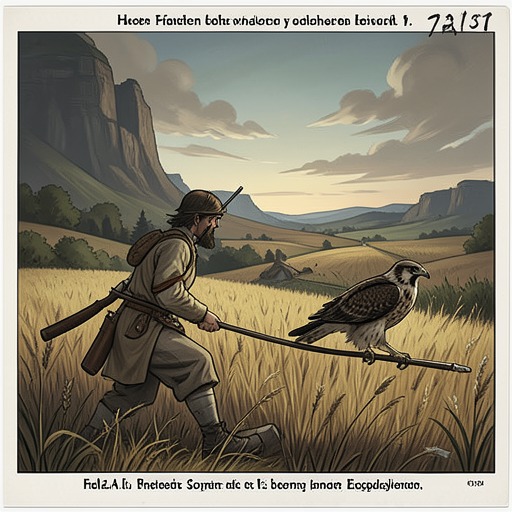
Macdonald is holding Mabel the goshawk, who is watching the deer too. Unable to resist the impulse to get closer, Macdonald walks downhill towards them, aware that she is technically trespassing. As her approach presses upon the herd, individual deer move to the right; the animals walk and then canter in a long line along the valley floor towards the wood at the field’s far edge, roughly half a mile away. The movement is at once orderly and dispersive: the herd becomes a procession, then disappears into the wood. Mabel ignores the European hare while watching them.
The departure divides the scene. The deer run towards the wood on the hill to the right, while the European hare escapes towards the field margin on the hill to the left. Once both have gone, the landscape before Macdonald is empty of them, leaving wind, chalk and wheat. The animals have not merely decorated the view; their separate movements have shaped its brief action and its sudden absence.
Introduced animals and layered histories
The deer’s appearance prompts Macdonald to consider the histories of animals living in the countryside. Fallow deer, she notes, were certainly introduced. European hares are thought to have been brought by the Romans; pheasants came from Asia Minor; the partridges in the area originally came from France, though those she sees there were hatched in game-farm incubators. The squirrel on a sweet chestnut tree came from North America, and rabbits were medieval introductions. These histories connect the apparent local scene to trade, invasion, farming, hunting and settlement.
That context complicates any easy equation between familiar wildlife and an untouched national past. The deer can feel as though they belong to the chalk valley: they recur there, and local walkers know them. Yet their presence also records movement and human intervention. The passage holds both facts together. The animals possess the ground in the present, while the account of how species arrived unsettles the idea that belonging must mean ancient, unchanging origin.
Local recognition and the claim of Old England
On the walk back, Macdonald meets a retired couple from her mother’s village, whom she often encounters walking a white-muzzled terrier. They do not know one another’s names, but the couple know that her hawk is called Mabel. Macdonald tells them happily that she has seen the deer, describing the large, dark-coated herd at the bottom of the valley. The couple share her pleasure: they call the deer special and beautiful, and say that they see them often. They once counted them; the usual number, the man says, is between twenty-five and thirty.
Their familiarity establishes a genuine, shared attachment to place. The conversation changes when the man asks whether the deer give Macdonald hope, then explains that he finds it a relief that a real bit of Old England remains despite immigrants coming in. The claim makes the herd a symbol in an exclusionary account of national belonging. Macdonald does not answer. The words hang in the silence; she says goodbye and walks home with Mabel the goshawk through the rain, distressed by what she did not say.
The deer as a challenge to pastoral myth
On the walk, Macdonald connects the couple’s remark to the chalk-cult and its myths of blood belonging: stories that sanctify a supposed organic bond between people and landscape through an imagined lineage. She recalls that such myths can erase other cultures, histories, and ways of living in a place. Her unease extends beyond the conversation to the bronze falcon associated with a hateful history, Göring’s plans to exclude Jews from German forests, and other histories of movement and belonging, including Finnish goshawks making the Brecklands their home, her grandfather speaking only Gaelic until he was ten, and a Lithuanian builder’s bewilderment that people he met in England did not know which woodland mushrooms were edible.
The deer’s significance therefore remains deliberately double. They inspire wonder as a living herd, observed in detail and encountered at close range; they are also recruited by the couple into a nostalgic national story that their own introduced history complicates. The scene does not deny the couple’s local knowledge or shared delight in the animals. Instead, it reveals how affection for a place can coexist with a damaging idea of who belongs there—and how easily a landscape’s complicated histories can be replaced by safer, simpler ones.